U.S. Army Delta Force
Operation NapoleonU.S. Army Delta Force is the armed and security force attached to the secret operation on Vatnajökull Glacier. Its presence turns an attempted aircraft recovery into a tightly controlled military undertaking: its officers guard the wreck, communications are restricted to a closed channel, and documents are to be collected and delivered only to the operation’s senior commander. The novel presents the force less through a formal account of its structure than through the boundaries it enforces around the wreck and the information it contains.
Mission and Secrecy
The operation’s covert character is explicit in a Washington discussion about what the crashed plane carried and why Delta Force had been involved alongside Ratoff. Carr responds by raising the history of the Walchensee gold: shortly before the fall of Berlin, a freight train carried more than three hundred small bags, each containing a gold bar, away from the Reichsbank on Hitler’s orders. He then reveals the politically charged origin of most of that gold: it had been taken from concentration camps. The secretary recognizes the implications for a German aircraft under U.S. command, associating its cargo with plundered Jewish gold. Delta Force’s presence is therefore linked to a recovery whose contents could expose a history far more compromising than an ordinary wartime wreck.
The military’s Iceland surveillance is presented as operating under the nations’ defence treaty. At an emergency meeting with Icelandic ministers, an American admiral insists that nothing said in the room be disclosed, while a general explains that U.S. forces monitor activity within and around Iceland’s borders using submarines, reconnaissance planes, and satellites. The general identifies a section of Vatnajökull Glacier as a particular focus of recent monitoring. This account places the glacier operation within a wider surveillance system, even as the insistence on secrecy signals that treaty-based monitoring does not explain everything the Americans are doing there.
Securing the Aircraft and Its Records
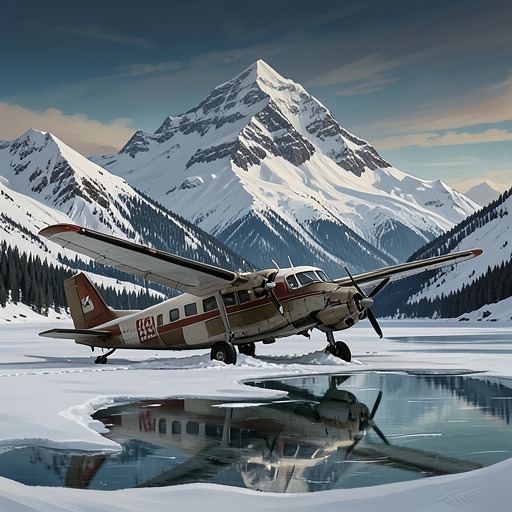
When the aircraft’s front section breaks away and collapses onto the ice, Ratoff orders the severed portion prepared for removal and forbids anyone to enter the plane without his express permission. Four Delta Force officers stand guard outside while he enters the cabin, the first passenger to go aboard in more than half a century. The scene makes the unit’s immediate function concrete: it protects both the wreck and Ratoff’s exclusive access to what lies inside.
Afterward, Ratoff reports finding the general’s locked aluminium briefcase, a pilot’s logbook, and another book, while claiming not to have opened or examined them. Carr orders him to take every written item into his safekeeping and deliver it to Carr alone, excluding everyone else from access. He stresses that every scrap matters and warns Ratoff that remaining ignorant of the documents would be to his advantage. The exchange shows how the operation’s security extends from guarding a physical site to managing the evidence that could explain it.
That control is also built into the communications procedure. When Carr contacts Ratoff, Ratoff gestures for the communications officer to leave the tent and waits until he is alone before continuing. All communication from the glacier is conducted on the Delta Force closed channel. The force thus supplies not only armed guards but a restricted line of command through which information from the site can be filtered.
Armed Presence and Political Pressure
The operation’s military perimeter becomes visible to the Reykjavík Air-Ground Rescue Team on the glacier. At 2315 GMT on Saturday 30 January, about twenty soldiers approach on snowmobiles under powerful headlamps. Their helmets and goggles conceal their faces; rifles are slung over their backs. They halt together as if defending an invisible line. Júlíus’s roughly seventy rescuers, by contrast, approach on skis, snowmobiles, and two tracked vehicles in luminous orange jackets. The armed military presence and the rescuers’ conspicuous, practical visibility make competing purposes legible before negotiations begin.
The confrontation unfolds against the Icelandic government’s demand for disclosure. The prime minister threatens a formal protest, public investigations in Iceland and America, closure of roads between the glacier and the base, and a personal address to the nation, particularly after two rescue-team members have been injured. The American general counters by disclosing that there is a German bomb on the glacier and that the operation to remove it is delicate; he urges the prime minister to call the team home. The warning gives the military a reason to press for control, but it also underscores the stakes of keeping the operation inaccessible to Icelandic authorities.
Denial and the Limits of the Cover Story
The bomb account is not the only explanation circulated around the recovery. When a flight lieutenant asks whether a bomb is in the plane and requests permission to inspect the cargo before transport, Ratoff tells him to trust that there is no bomb in the aircraft. He describes it as a German plane dating from World War II, says it is safe, and denies having heard of any Nazi bomb or of Armstrong searching for it. Another pilot then asks why the crew cannot watch the work if the aircraft is harmless. The exchange leaves the force’s function in a revealing tension: its personnel enforce a highly restricted operation while those asked to support it receive assurances that do not resolve their questions. In the novel, U.S. Army Delta Force embodies the practical power of that secrecy, guarding the site and its records while competing explanations of the danger circulate around the glacier.